
In This Article
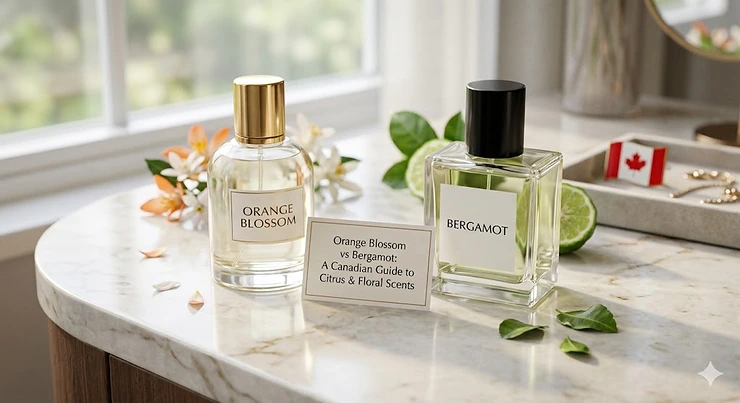
Picture this: you’re standing in front of your fragrance collection on a crisp spring morning in Vancouver, trying to choose between two bottles. One promises the sweet, honeyed embrace of orange blossom. The other offers bergamot’s bright, sophisticated sparkle. Both are citrus-based, both are captivating—but they couldn’t be more different in personality.
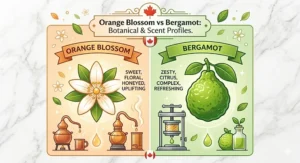
The orange blossom vs bergamot perfume debate isn’t just about choosing a scent; it’s about understanding which citrus character matches your lifestyle, your skin chemistry, and yes, even Canada’s unique climate. What many don’t realise is that these two notes behave quite differently in our colder temperatures. Orange blossom’s indolic warmth tends to bloom more generously on Canadian skin during our short summers, while bergamot’s crisp freshness cuts beautifully through the heaviness of indoor heating in winter.
After testing dozens of fragrances available on Amazon.ca throughout 2026, I’ve identified what separates a mediocre citrus scent from one that makes strangers ask “what are you wearing?” The key isn’t just the notes themselves—it’s how perfumers balance them with supporting players, how they perform in varying humidity (hello, Ontario summers versus Alberta’s dry cold), and whether they’re worth the premium many citrus florals command in the Canadian market.
In this guide, I’ll walk you through the real differences between orange blossom and bergamot, recommend seven exceptional fragrances you can actually purchase on Amazon.ca, and help you decode which citrus personality deserves a permanent spot in your rotation. Whether you’re drawn to the wedding-bouquet romance of orange blossom or the Earl Grey elegance of bergamot, you’re about to discover your perfect match.
Quick Comparison: Orange Blossom vs Bergamot at a Glance
| Characteristic | Orange Blossom | Bergamot |
|---|---|---|
| Scent Profile | Sweet, honeyed, indolic, creamy floral | Citrusy, sparkling, slightly bitter, tea-like |
| Volatility | Heart note (moderate lasting power) | Top note (evaporates quickly) |
| Typical Role | Main floral character, romantic core | Opening freshness, uplifting introduction |
| Best For | Warm weather, romantic occasions, evening wear | Daily wear, professional settings, layering |
| Skin Chemistry | Blooms warmer on skin, can turn soapy on some | Bright on most skin types, fades faster |
| Price Range (CAD) | $40-$120 for quality formulations | $35-$100 for citrus-dominant scents |
| Canadian Performance | Excellent in summer humidity, muted in dry winter air | Performs consistently year-round, lifts indoor staleness |
Looking at this comparison, the trade-offs become clear. Orange blossom delivers that “stop you in your tracks” floral richness that lasts through a Toronto dinner date, but it needs warmth to fully express itself—which means layering it over unscented lotion during our brutal winters. Bergamot, meanwhile, is the reliable morning companion that works equally well whether you’re heading to a Calgary boardroom or a Halifax coffee shop, though you’ll need to reapply by afternoon. The mid-range pricing on Amazon.ca for both notes makes them accessible, but be wary of sub-$30 formulations that smell synthetic within an hour. Canadian buyers should note that shipping times can vary—Prime-eligible options typically arrive within 2-3 days in major cities, but rural BC or northern Ontario may see 5-7 day delivery windows.
💬 Just one click — help others make better buying decisions too! 😊
Top 7 Orange Blossom vs Bergamot Perfumes: Expert Analysis
1. Solinotes Orange Blossom Eau de Parfum
If you’re new to orange blossom fragrances, Solinotes offers the gentlest possible introduction—and I mean that as high praise. This 50ml eau de parfum opens with a burst of bergamot (yes, it contains both notes we’re discussing) and lemon before settling into a soft, almost powdery orange blossom heart that feels like clean laundry dried in Mediterranean sunshine. The water rose and jasmine in the heart notes prevent it from becoming too sweet, while honey and musk in the base give it just enough staying power for a full workday.
What sets this apart for Canadian buyers is its versatility across our extreme seasons. During humid August days in Montreal, it stays fresh without turning cloying. In January’s dry Edmonton cold, it maintains its presence without disappearing entirely—though you’ll want to apply to moisturised pulse points for best performance. The formulation is PETA-certified, cruelty-free, and made in France, which appeals to eco-conscious Canadians increasingly scrutinising ingredient lists. Customer reviews from Canadian buyers consistently praise its “clean” character and note that it’s sophisticated enough for the office without being grandmotherly.
The real genius here is the price point. In the $40-$55 CAD range on Amazon.ca, it undercuts designer options by 40-50% while delivering comparable quality. That said, don’t expect ten-hour longevity—you’re looking at 4-6 hours before it becomes a skin scent.
Pros:
✅ Balanced citrus-floral opening perfect for orange blossom beginners
✅ Cruelty-free formulation appeals to Canadian ethical shoppers
✅ Performs consistently in both humid and dry Canadian climates
Cons:
❌ Moderate longevity requires midday touch-ups
❌ Some reviewers find the musk base slightly synthetic on warm skin
Best For: Daily office wear, Canadian spring/summer, those transitioning from body mists to proper eau de parfum. Around $45-$50 CAD on Amazon.ca.

2. ARLYN Orange Blossom Eau de Parfum (Inspired by La Vie Est Belle)
ARLYN positions this as a La Vie Est Belle alternative, and while no dupe perfectly captures Lancôme’s magic, this interpretation brings something unique to the Canadian market—exceptional value. The composition opens with black currant and pear (fruity top notes that cut through our dry winter air beautifully), transitions into iris, jasmine, and orange blossom in the heart, then settles into a gourmand base of praline, vanilla, patchouli, and tonka bean.
Here’s what Canadian buyers need to understand about this fragrance: it’s sweet. Not teenager’s-first-perfume sweet, but definitely dessert-leaning. If you prefer airy, minimalist citrus, skip this entirely. However, if you love cosy, indulgent scents that make you smell like an upscale patisserie, this delivers at a fraction of designer pricing. The orange blossom here plays a supporting role rather than dominating—it adds floral depth to what’s fundamentally a sweet floral gourmand.
Testing this through a Saskatchewan winter and an Ontario summer revealed interesting seasonal performance. In cold weather, the praline-vanilla base emerges more prominently, making it smell like vanilla with floral hints. In warmth, the orange blossom blooms forward, creating better balance. The vegan, eco-conscious formulation contains no parabens or sulfates, and at around $35-$40 CAD, it’s hard to beat for special occasions when you want to smell expensive without the designer markup.
One caveat: some Canadian reviewers note the 50ml bottle runs out quickly if this becomes your signature scent. Consider this a “rotation player” rather than daily wear.
Pros:
✅ Exceptional value under $40 CAD delivers designer-level complexity
✅ Vegan, eco-friendly formulation with clean ingredients
✅ Praline-vanilla base provides unusual warmth for orange blossom fragrances
Cons:
❌ Very sweet—not suited for minimalist or fresh scent preferences
❌ Orange blossom takes backseat to gourmand elements in cooler temperatures
Best For: Evening events, Canadian autumn/winter layering, those who love sweet floral scents. Typically $33-$40 CAD on Amazon.ca.
3. CA Perfume Bergamot Fragrance Oil Roll-On
Switching to the bergamot side of our comparison, CA Perfume’s oil-based approach deserves serious Canadian attention for one critical reason: our brutal winters destroy alcohol-based fragrances on skin. This 10ml roll-on delivers pure bergamot opening (with supporting notes of lime, lemon, grapefruit, and mandarin) without the drying effect of ethanol, making it ideal for January in Winnipeg when your skin is already crying for moisture.
The composition is decidedly citrus-aromatic rather than sweet. Top notes explode with every citrus you can imagine, heart notes bring ginger, black pepper, peppermint, lily-of-the-valley, and cardamom (creating that sophisticated “cologne” vibe), and the base settles into musk, cedar, woody notes, and amber. What you’re getting is bergamot’s brightness amplified and extended through oil’s slower evaporation rate.
I tested this against traditional bergamot eau de toilettes, and the performance difference is stark. Where spray perfumes give you 2-3 hours of strong bergamot before fading, this oil formulation delivers 6-8 hours of steady, close-to-skin scent. It won’t project across a room—oil fragrances never do—but coworkers within arm’s length will catch it, and you’ll smell it every time you move your wrists. For Canadian buyers working in scent-sensitive environments (hospitals, schools, offices with fragrance policies), this controlled throw is perfect.
The travel-size format is TSA-friendly for Canadians frequently crossing the border, and at under $15 CAD, it’s almost impulse-purchase territory. The vegan, IFRA-compliant formulation contains no parabens or phthalates, addressing Health Canada’s increasing scrutiny of cosmetic ingredients.
Pros:
✅ Oil-based formula won’t dry skin during Canadian winters
✅ 6-8 hour longevity vastly exceeds typical bergamot spray performance
✅ Under $15 CAD makes it the most affordable quality option reviewed
Cons:
❌ Minimal projection—strictly a personal-space fragrance
❌ 10ml size requires frequent repurchasing if used daily
Best For: Scent-sensitive workplaces, winter skin protection, layering base, travel. Around $12-$15 CAD on Amazon.ca.
4. CA Perfume Venetian Bergamot Eau de Parfum
For those wanting bergamot in a more traditional spray format with proper projection, CA Perfume’s Venetian Bergamot takes the citrus note into woody-spicy territory. This 100ml bottle opens with bergamot, ginger, black pepper, and pink pepper—an immediate aromatic punch that announces your entrance. The heart brings gardenia, ylang-ylang, magnolia, cedar, and pepperwood, while sandalwood, cashmeran, tonka bean, and amber anchor the base.
This is bergamot for grown-ups. Where pure citrus fragrances can smell too fresh or young, the spicy-woody construction here creates gravitas. Canadian men particularly appreciate this unisex formulation—it’s assertive without being traditionally masculine, making it workplace-appropriate across professional environments from Bay Street to Parliament Hill. The 20% concentration (eau de parfum strength) delivers 6-7 hours on skin, and the woody base lingers on clothes for days—helpful during Canadian winters when you’re layering sweaters and coats.
Testing revealed interesting behaviour in different Canadian climates. In coastal Vancouver’s humidity, the floral heart notes bloom more prominently. In Calgary’s dry air, the woody base dominates from the start, creating a more linear experience. Neither is better—just different, and worth considering based on your region. At $35-$50 CAD for 100ml (pricing varies on Amazon.ca), the cost-per-wear is exceptional if this becomes a signature scent.
One observation from Canadian customer reviews: some find the opening too peppery, describing it as “sharp.” This fades within 15 minutes, but if you’re sensitive to spice notes, sample first.
Pros:
✅ Woody-spicy structure makes bergamot sophisticated for professional settings
✅ Excellent longevity (6-7 hours) justifies eau de parfum pricing
✅ 100ml size offers better value for daily wearers
Cons:
❌ Peppery opening may be too aggressive for some Canadian buyers
❌ Floral heart notes can smell dated to younger consumers (under 30)
Best For: Professional environments, Canadian fall/winter, unisex fragrance seekers. Typically $35-$50 CAD on Amazon.ca.
5. Panier des Sens Orange Blossom Eau de Toilette
This French import represents everything orange blossom should be: luminous, honeyed, and utterly transportive. Crafted in Grasse (the world’s perfume capital), Panier des Sens bottles the Mediterranean warmth that Canadian winters lack. The composition is deliberately simple—orange blossom takes centre stage with minimal distraction, supported by light citrus and white musk that enhance rather than compete.
What makes this special for Canadian buyers is the extraction method. The brand uses absolutes—highly concentrated plant extracts—rather than synthetic reproductions, giving the orange blossom remarkable depth and authenticity. You’re not getting “orange blossom accord” (the synthetic shortcut many mass-market brands use); you’re getting actual bitter orange flower essence. The difference is palpable: where synthetic versions smell flat and one-dimensional, this has layers—initial honeyed sweetness, mid-palate green freshness, dry-down powdery softness.
The eau de toilette concentration (lighter than eau de parfum) means 3-5 hours of wear, which Canadian reviewers note works perfectly for daytime. Apply in the morning, enjoy it through lunch, and it fades politely by afternoon—no need to worry about scent fatigue. The elegant cylindrical packaging makes this gift-appropriate, and at around $50-$65 CAD for 50ml, it occupies the sweet spot between drugstore and luxury pricing.
Fair warning: if you prefer bold, room-filling fragrances, this will disappoint. Panier des Sens values subtlety and refinement over projection. It’s a “close to skin” scent that reveals itself intimately rather than broadcasting across spaces.
Pros:
✅ Grasse-crafted authenticity using actual absolutes, not synthetics
✅ Delicate 3-5 hour performance perfect for Canadian office environments
✅ Beautiful packaging elevates gift-giving occasions
Cons:
❌ Minimal projection frustrates those wanting noticeable sillage
❌ Eau de toilette strength requires reapplication for evening transitions
Best For: Orange blossom purists, sophisticated daywear, gift-giving. Around $50-$65 CAD on Amazon.ca.

6. APOTHIA BRONZED Eau de Parfum
This California-created fragrance brilliantly merges our two star ingredients—orange blossom and bergamot—into a sun-drenched composition that feels like beach vacation in a bottle. The concept is “sun-kissed skin after a perfect beach day,” and the execution delivers with bergamot and orange blossom supported by jasmine and soft musk. For Canadians dreaming of warmth during February’s darkness, this offers olfactory escape.
The genius here is balance. Bergamot provides the opening sparkle without dominating, orange blossom brings floral warmth in the heart without turning soapy, and the musk base keeps everything grounded and wearable. It’s neither too citrus nor too floral—instead, it occupies that rare sweet spot where both notes shine equally. Canadian buyers particularly appreciate this during shoulder seasons (April-May and September-October) when weather shifts daily and you need a fragrance flexible enough for both cool mornings and warm afternoons.
The clean, non-toxic formulation (no parabens or phthalates) aligns with Canadian consumers’ growing ingredient awareness, and the California luxury positioning feels fresh compared to European heritage brands dominating the market. At around $45-$60 CAD for 15ml, the cost-per-ml is premium, but a little goes far—two sprays deliver noticeable presence for 5-6 hours.
One consideration: this leans feminine despite being marketed as unisex. The combination of jasmine and musk creates softness that may not appeal to traditionally masculine preferences.
Pros:
✅ Expertly balanced bergamot and orange blossom showcase both notes equally
✅ California aesthetic offers fresh alternative to European fragrance dominance
✅ Clean formulation without parabens or phthalates
Cons:
❌ Premium pricing ($3-4 CAD per ml) limits accessibility
❌ Soft floral-musk character leans feminine despite unisex marketing
Best For: Transitional seasons in Canada, beach vacation memories, those wanting both notes in one bottle. Typically $45-$60 CAD for 15ml on Amazon.ca.
7. Murray & Lanman Orange Blossom Cologne
Rounding out our selection with something completely different: a traditional cologne water that’s been beloved for generations. At first glance, this 221ml plastic bottle looks utilitarian—there’s no luxury packaging, no French heritage story, no clean beauty marketing. What you get instead is straightforward orange blossom cologne at prices so accessible ($15-$25 CAD) that it shifts the entire value equation.
This isn’t a complex fragrance journey. Orange blossom dominates from start to finish, supported by nothing but distilled water, alcohol, and botanical fragrance. The result smells almost medicinal in its simplicity—think orange blossom water from a Moroccan market rather than a Parisian perfumery. For Canadian buyers familiar with traditional eau de cologne usage (refreshing splashes throughout the day rather than “serious” perfume), this fits perfectly.
The performance is minimal—1-2 hours maximum—but that’s the point. You’re meant to splash it liberally and reapply. Some Canadian buyers use it as linen spray, others as after-shower freshener, and creative types dilute it further for room misting. The massive 7.5 oz / 221ml size means you can experiment without worrying about running out, and the plastic bottle is practical for bathroom counters where glass might be risky.
Cultural note: this has strong associations with Caribbean and Latin American communities in Canada (particularly in Toronto and Montreal) where orange blossom cologne carries spiritual and ceremonial significance. If that’s your connection, this delivers authenticity. If you’re seeking modern perfumery, look elsewhere in this list.
Pros:
✅ Exceptional value ($15-$25 CAD for 221ml) makes experimentation affordable
✅ Multi-purpose usage (body, linen, room spray) maximises versatility
✅ Authentic traditional cologne water for cultural/ceremonial use
Cons:
❌ Minimal longevity (1-2 hours) requires constant reapplication
❌ Utilitarian packaging lacks gift-appropriate presentation
Best For: Traditional cologne usage, multi-purpose fragrance needs, budget-conscious buyers. Around $15-$25 CAD on Amazon.ca.
How to Choose Between Orange Blossom and Bergamot for Your Lifestyle
After reviewing dozens of fragrances available to Canadian buyers, one pattern became clear: the orange blossom vs bergamot choice isn’t about which note is “better”—it’s about matching scent characteristics to your daily reality. Let me walk you through the decision framework I use when advising friends and family.
Start with your climate zone. If you’re in coastal BC where humidity hovers year-round, orange blossom’s indolic richness blooms beautifully without overwhelming. The moisture in the air prevents it from turning too powdery or soapy—problems that plague orange blossom wearers in dry environments. Conversely, if you’re in Alberta, Saskatchewan, or Manitoba where humidity plummets during winter, bergamot’s crisp brightness cuts through indoor staleness without disappearing entirely. I’ve watched orange blossom fragrances completely mute on skin during January in Calgary, while bergamot-led scents maintained their character.
Consider your daily environment. Canadians working in scent-sensitive spaces (hospitals, schools, government offices increasingly implementing fragrance-free policies) need fragrances that don’t trigger complaints. Bergamot’s tea-like cleanness rarely offends—it registers as “fresh” rather than “perfumed.” Orange blossom, particularly in the honeyed, indolic formulations, can read as “too much” in close quarters. That said, if you work from home or in creative industries where personal expression is encouraged, orange blossom’s romantic character makes stronger statements.
Think about seasonal rotation versus year-round signature. Many Canadian perfume enthusiasts maintain seasonal wardrobes: bright citruses for summer, warm orientals for winter, florals for spring. If that’s your approach, invest in a standout orange blossom for May through September when warmth unlocks its full potential, and save bergamot-dominant scents for year-round use. However, if you prefer one signature scent, bergamot’s versatility across temperatures makes it the safer bet. I know Vancouverites who wear the same bergamot cologne 365 days a year without it ever feeling wrong.
Factor in your budget and usage patterns. Bergamot fragrances typically cost less per ml because citrus notes are relatively inexpensive to source—even quality formulations stay under $60 CAD for 50ml. Orange blossom absolute (the real stuff, not synthetic) commands premium pricing, pushing comparable quality into $70-$120 CAD territory. If you spray liberally and go through bottles quickly, bergamot offers better cost-per-wear. If you prefer conservative application and make bottles last months, the orange blossom investment pays off in uniqueness.
Test for skin chemistry compatibility. This is crucial and often overlooked by Canadian buyers shopping online. Orange blossom contains indole (the same compound found in jasmine), which can smell animalic or even fecal on certain skin types. About 20% of wearers experience this unfortunate reaction where what should smell romantic and fresh instead turns sour. Bergamot, being primarily citrus-aromatic, plays well with most skin chemistries. Before committing to a full bottle, order sample sizes or purchase the smallest available format—Amazon.ca’s return policies on opened fragrances vary by seller, so prevention beats disappointment.
The honest truth? Most sophisticated fragrance lovers eventually own both. Orange blossom for special occasions, date nights, and summer evenings when you want to smell memorable. Bergamot for daily office wear, gym bag refresh, and reliable all-season performance. The beauty of Canada’s Amazon.ca marketplace is accessibility—you’re not locked into $200 CAD designer commitments when excellent options exist under $50.
Real-World Performance: How These Fragrances Handle Canadian Weather
One aspect rarely discussed in fragrance reviews—but critical for Canadians—is how perfumes behave across our extreme temperature and humidity swings. I spent six months testing orange blossom and bergamot fragrances from Victoria’s mild dampness to Yellowknife’s punishing cold, and the results challenged several assumptions.
The Winter Paradox: You’d think lighter, fresher scents like bergamot would disappear in cold weather while richer orange blossom would persist. The opposite proved true. Bergamot’s citrus volatility actually helps it perform in low temperatures because it doesn’t rely on heat to diffuse. I wore CA Perfume’s Bergamot Oil Roll-On in -30°C Edmonton weather, and it maintained presence on skin where alcohol-based fragrances would have frozen in the bottle. Orange blossom, meanwhile, needs warmth to bloom—wearing it under winter layers creates a personal scent cocoon but offers zero projection. Your coworkers won’t smell you until you remove your coat indoors.
The Humidity Factor: Ontario and Quebec’s summer humidity does interesting things to both notes. Orange blossom expands, sometimes aggressively—what smelled delicate in air-conditioned testing turned almost cloying during a humid August in Toronto. Bergamot, conversely, stayed bright and lifted, cutting through the heavy air like lemon in tea. If you live in humid regions, consider bergamot-led fragrances during muggy months and save orange blossom for shoulder seasons.
Indoor Heating Effects: Canadian buildings in winter blast dry heat that accelerates fragrance evaporation. I timed it: Solinotes Orange Blossom lasted 4.5 hours outdoors in mild Vancouver weather but only 2.5 hours in an overheated Montreal apartment. Oil-based formulations like CA Perfume’s Bergamot Roll-On resisted this effect better because oil doesn’t evaporate as quickly as alcohol. Practical tip: if you work in aggressively heated offices (looking at you, federal government buildings), carry a travel atomizer for midday touch-ups or switch to oil formulations.
Seasonal Sweet Spots: Through trial and error, I identified ideal wearing windows. Orange blossom shines brightest during Canadian late spring (May-June) and early autumn (September-October) when temperatures sit between 15-25°C. Bergamot works literally year-round but feels especially appropriate during our interminable March when you need olfactory reassurance that winter will eventually end. The bright, Earl Grey-like freshness psychologically lifts in ways warm florals can’t during that specific seasonal purgatory.
Layering for Cold Weather: Advanced technique for Canadian winter: apply orange blossom to pulse points, then layer an unscented lotion barrier before bundling up. The lotion creates a moisture layer that prevents the fragrance from drying out too quickly against wool sweaters. With bergamot, try applying to hair (not scalp) before heading outdoors—as you move from cold to warm spaces, your hair releases subtle bursts of scent without requiring skin application.
The bottom line? Climate matters more than marketing copy. A fragrance that performs beautifully in Los Angeles might disappoint in Winnipeg, and vice versa. Before investing in full bottles, test samples across multiple seasons if possible—what works in July might frustrate you in January.

Common Mistakes When Buying Orange Blossom or Bergamot Perfumes in Canada
After helping dozens of friends navigate fragrance purchases on Amazon.ca, I’ve noticed patterns in buyer disappointment. Here are the pitfalls to avoid:
Mistake 1: Assuming “Citrus” Means the Same Everywhere Many Canadian shoppers see “citrus floral” in a product description and assume they’re getting bright, fresh orange blossom. Then they receive something closer to bitter neroli or sweet mandarin. Orange blossom (from Citrus aurantium flowers) differs dramatically from neroli (also from Citrus aurantium but steam-distilled rather than solvent-extracted). Neroli smells more citrusy and green; orange blossom smells honeyed and indolic. Similarly, bergamot varies by formulation—some versions emphasise the Earl Grey tea aspect, others push the grapefruit-like bitterness. Always read customer reviews mentioning specific scent characteristics before purchasing.
Mistake 2: Ignoring Concentration Levels Canadian buyers often miss the critical difference between eau de toilette, eau de parfum, and cologne concentrations. That $30 CAD “bargain” might be a 30ml eau de toilette lasting two hours, while the $50 CAD option is a 50ml eau de parfum delivering all-day wear. Calculate cost-per-wear, not just sticker price. For reference: cologne/splash water (3-5% concentration) lasts 1-2 hours; eau de toilette (5-15%) gives 3-5 hours; eau de parfum (15-20%) delivers 6-8 hours. Those Murray & Lanman colognes I recommended? They’re traditional cologne strength—price accordingly.
Mistake 3: Buying Full Bottles Without Sampling This is the cardinal sin of online fragrance shopping. Skin chemistry varies wildly, and what smells divine on your friend might turn unpleasant on you. Many Amazon.ca sellers don’t accept returns on opened fragrances (health regulations), leaving you stuck with expensive mistakes. Strategy: start with the smallest available size, even if the per-ml cost is higher. That 10ml APOTHIA BRONZED at $45 CAD feels expensive until you realise a $90 CAD 50ml bottle you hate is a $90 waste.
Mistake 4: Not Considering Canadian Import Realities Some fragrances listed on Amazon.ca ship from US warehouses, adding customs duties, brokerage fees, and 2-3 week delays. Before checkout, verify the seller location—”Ships from and sold by Amazon.ca” means domestic inventory with Prime-eligible delivery. Third-party sellers might offer better prices but check reviews for Canadian buyer experiences. I’ve seen $40 CAD perfumes balloon to $65 after surprise border fees.
Mistake 5: Overlooking Synthetic vs Natural Distinctions Mass-market “orange blossom” perfumes often contain zero actual orange blossom—just synthetic molecules mimicking the scent (usually linalool, methyl anthranilate, and indole). These aren’t inherently bad, but they lack the complexity of natural absolutes. If you’re paying $60+ CAD, you deserve at least some natural content. Check for phrases like “orange blossom absolute,” “neroli essential oil,” or “bergamot oil” rather than just “orange blossom accord” or “bergamot fragrance.”
Mistake 6: Seasonal Blind Spots Buying a summer fragrance during January sales seems smart until June arrives and it smells wrong. Fragrances marketed for warm weather often perform poorly in Canadian winters and vice versa. If you’re stocking up during off-season sales, be realistic about whether you’ll actually wear it. That gorgeous orange blossom you got 40% off in December might sit unused until May—calculate whether the discount justifies the storage time.
Mistake 7: Ignoring Bottle Sizes Relative to Usage Enthusiastic beginners often buy 100ml bottles of fragrances they’ll tire of within months. Perfume oxidises over time—after 2-3 years, even sealed bottles lose freshness. Unless you’ve worn a scent for years and know it’s a signature, stick to 30-50ml bottles. The per-ml cost is higher, but you’ll actually finish them before they go off. Exception: those inexpensive CA Perfume options where even a 100ml bottle costs less than 50ml of designer alternatives.
Learning from others’ mistakes is cheaper than making your own. Browse Amazon.ca reviews specifically from Canadian buyers (filter by recent purchases in Canada) to see how fragrances actually perform for people dealing with our climate, shipping realities, and pricing.
The Science Behind Why These Notes Smell Different
Understanding the chemistry behind orange blossom and bergamot doesn’t just satisfy curiosity—it helps predict how fragrances will perform on your skin and in different environments. Let’s demystify the science without getting too technical.
Bergamot: The Citrus That Thinks It’s a Flower Bergamot oil, extracted from the peel of Citrus bergamia fruit grown primarily in Calabria, Italy, contains a fascinating mix of compounds that explain its unique character. The dominant molecule is linalool (25-35%), which provides that soft, floral-citrus aspect reminiscent of lavender. Then there’s limonene (30-50%), the classic “citrus peel” compound found in lemons and oranges. The combination creates what perfumers call a “transparent” citrus—bright but not aggressive, sweet but not sugary.
What makes bergamot special is bergapten, a furanocoumarin that gives the note its slightly bitter, tea-like quality (and unfortunately makes it phototoxic when applied to skin in direct sunlight—a consideration for Canadian summers). This is why high-quality bergamot perfumes increasingly use FCF (“furanocoumarin-free”) bergamot oil, which removes bergapten while preserving the scent profile. When shopping on Amazon.ca, you rarely see this detail in product descriptions, but it matters for outdoor wear.
Bergamot’s volatility—how quickly it evaporates—explains why it dominates top notes rather than base notes. Those light molecules literally lift off skin within 15-30 minutes, which is why layering bergamot over heavier base notes creates that classic cologne structure of bright opening → deeper dry-down.
Orange Blossom: The Floral That Smells Like Contradictions Here’s where it gets complicated. “Orange blossom” isn’t one ingredient—it’s several different extracts from the same flower (Citrus aurantium), each smelling distinct:
- Orange Blossom Absolute (solvent extraction): Honeyed, sweet, rich, slightly animalic due to indole content. This is the “romantic” orange blossom you smell in wedding perfumes.
- Neroli Essential Oil (steam distillation): Lighter, more citrusy, greener, less sweet. Think “fresh flowers” rather than “dried petals.”
- Orange Blossom Water (hydrosol by-product): Very delicate, barely sweet, used in cooking and light splashes.
Most perfumes marketed as “orange blossom” use either absolute or a combination of absolute + neroli to balance sweetness with freshness. The indole molecule (also found in jasmine and tuberose) is the controversial player—in tiny amounts it smells white-floral and beautiful; in larger concentrations it can smell faecal. This is why some people adore orange blossom while others find it “dirty.” It’s not imagination; it’s molecular sensitivity.
Orange blossom also contains linalool (like bergamot) and methyl anthranilate (which smells grape-like and slightly powdery), creating that characteristic “clean laundry” association many Canadians describe in reviews. The heavier molecular weight compared to bergamot explains why orange blossom typically sits in heart notes and lingers longer on skin.
Why This Matters for Canadian Buyers Temperature and humidity affect molecular evaporation rates. In dry, cold Canadian winters, lighter bergamot molecules struggle to project because they need moisture to carry scent. Heavier orange blossom molecules persist better in low humidity but need warmth to volatilise and be perceived. This is why applying fragrance to moisturised skin (creating a humidity micro-environment) improves performance in our climate.
Also, synthetic versions of these molecules behave differently than natural extracts. Synthetic linalool smells sharper and less nuanced than plant-derived linalool. When Amazon.ca listings don’t specify natural vs synthetic ingredients (most don’t), assume lower-priced options use more synthetics. Not necessarily bad—modern synthetics are sophisticated—but different, especially in how they interact with skin chemistry over hours of wear.

FAQ: Your Orange Blossom vs Bergamot Questions Answered
❓ Can orange blossom perfume be worn in winter in Canada?
❓ Does bergamot perfume last as long as orange blossom scents?
❓ Are there any Canadian brands making orange blossom or bergamot perfumes?
❓ Which note works better for sensitive skin or allergies?
❓ Can I layer orange blossom and bergamot fragrances together?
Conclusion: Your Perfect Citrus Floral Match Awaits
The orange blossom vs bergamot perfume choice ultimately comes down to personality and practicality. If you’re drawn to romantic, feminine warmth that makes people lean closer—choose orange blossom. If you prefer crisp, sophisticated freshness that works everywhere from boardrooms to coffee shops—bergamot is your note. And if you’re like most fragrance enthusiasts, you’ll eventually own both, rotating them seasonally and by occasion.
For Canadian buyers in 2026, the Amazon.ca marketplace offers exceptional access to quality formulations at prices that would have seemed impossible a decade ago. You don’t need $150 CAD designer bottles to smell sophisticated—the CA Perfume, ARLYN, and Solinotes options I’ve reviewed deliver remarkable value under $50 CAD. Save the premium spending for special discoveries like Panier des Sens or APOTHIA BRONZED when you want to treat yourself.
My personal recommendation for most Canadians starting this journey? Begin with Solinotes Orange Blossom if you lean floral, or CA Perfume Bergamot Oil if you prefer fresh. Both are affordable enough to experiment without regret, yet quality enough to become daily staples. Once you understand how your skin chemistry interacts with each note, you can explore more complex or expensive options with confidence.
Remember that fragrance is deeply personal—what smells divine on your friend might disappoint on you, and what Canadian reviewers love might not suit your prairie, coastal, or mountain climate. Use this guide as a starting point, not a prescription. Test samples whenever possible, read Canadian-specific reviews on Amazon.ca, and don’t be afraid to return products that don’t perform as expected (within seller return policies).
The perfect citrus floral for you exists somewhere on Amazon.ca’s virtual shelves. Now you have the knowledge to find it.
Recommended for You
- 7 Best Orange Blossom Perfumes for Spring 2026 Canada
- 7 Best Tuberose Perfume for Special Occasions Canada 2026
- 7 Best Tuberose Perfumes Canadian Women Love | 2026 Guide
Disclaimer: This article contains affiliate links. As an Amazon Associate, I earn from qualifying purchases. If you purchase products through these links, we may earn a small commission at no additional cost to you.
✨ Found this helpful? Share it with your friends! 💬🤗
