
In This Article
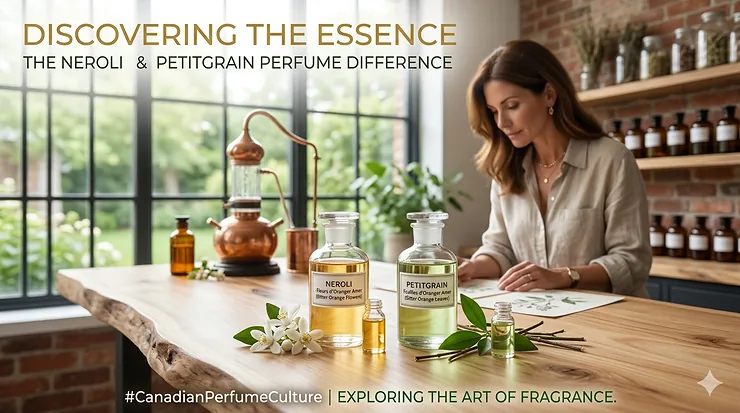
If you’ve ever wandered through a fragrance aisle wondering why some citrus perfumes smell fresh and green while others feel sweet and floral, you’ve stumbled into the fascinating world of bitter orange derivatives. The neroli petitgrain perfume difference isn’t just academic perfumery trivia—it’s the key to finding a scent that actually matches your personal style and Canadian lifestyle.

What’s remarkable about neroli and petitgrain is that they both come from the exact same tree: the bitter orange (Citrus aurantium). Yet they smell completely different because they’re extracted from different parts of the plant. Neroli is steam-distilled from the delicate white blossoms—producing a sweet, honeyed, floral scent with citrus brightness. Petitgrain, by contrast, comes from the leaves and twigs of the tree, delivering a greener, woodier, more herbaceous aroma with subtle citrus undertones.
For Canadian fragrance enthusiasts shopping on Amazon.ca, understanding this distinction matters because it transforms how you select perfumes for different seasons and occasions. Neroli-forward fragrances work beautifully for summer weddings and warm-weather weekends, while petitgrain-heavy compositions excel as fresh office scents during cooler Canadian months when you need something uplifting but not overwhelming.
The price point also differs significantly. Since it takes over 1,000 handpicked bitter orange blossoms to produce just one kilogramme of neroli oil, neroli-dominant perfumes typically cost more—expect to pay anywhere from $80 to $200 CAD for quality options on Amazon.ca. Petitgrain-based fragrances offer better value, usually ranging from $30 to $100 CAD, because leaves and twigs provide higher yields during extraction.
Quick Comparison: Neroli vs Petitgrain in Perfumes
| Feature | Neroli | Petitgrain | Best For |
|---|---|---|---|
| Plant Part | Bitter orange blossoms | Leaves and green twigs | Understanding extraction |
| Aroma Profile | Sweet, floral, honeyed, citrus | Green, woody, herbaceous, bitter | Scent selection |
| Longevity | 3-5 hours (top to middle note) | 4-6 hours (top to middle note) | Daily wear planning |
| Price Range (CAD) | $80-$200+ | $30-$100 | Budget decisions |
| Best Season | Spring/summer | Year-round | Canadian climate use |
| Complexity | Elegant, radiant, sophisticated | Fresh, grounding, natural | Occasion matching |
Looking at this comparison, the standout insight for Canadian buyers is versatility. Petitgrain fragrances work remarkably well across our four distinct seasons—crisp enough for August humidity in Toronto but warm enough for February commutes in Calgary. Neroli perfumes shine during warmer months but can feel almost too delicate when layered under heavy winter coats. The price differential reflects production realities: neroli’s labour-intensive harvest versus petitgrain’s sustainable, tree-friendly extraction from renewable leaves and twigs. For budget-conscious Canadians wanting that bitter orange family character, petitgrain-forward compositions deliver excellent value without sacrificing sophistication.
💬 Just one click — help others make better buying decisions too!😊
Top 7 Neroli & Petitgrain Perfumes: Expert Analysis
1. 100BON Neroli & Petit Grain Eau De Perfume
This French organic fragrance strikes a perfect balance between neroli’s floral sweetness and petitgrain’s green freshness, making it ideal for Canadian buyers who want both worlds in one bottle. The concentration sits at 15-20% essential oils, which translates to decent longevity for a natural formula—expect 4-5 hours on skin, considerably longer on clothing.
What sets 100BON apart is the refillable bottle design, addressing Canada’s growing environmental consciousness while offering value through reduced replacement costs. The formula uses organic wheat alcohol and oils from organic flowers and herbs, certified vegan and cruelty-free—appealing credentials for Canadian consumers who increasingly prioritize ethical sourcing. For Canadians dealing with dry winter skin, this alcohol-based formula may feel slightly drying; consider applying to pulse points on moisturised skin rather than spraying liberally.
Customer feedback from Canadian buyers highlights the opening burst of mandarin orange and lemon that quickly settles into jasmine-tinged neroli with petitgrain providing subtle green support in the base. One Toronto reviewer noted it “smells expensive but doesn’t last as long as synthetic alternatives”—a common trade-off with 100% natural fragrances. The scent works beautifully for office environments and casual weekend wear but lacks the projection for evening events.
Pros:
✅ 100% natural, certified organic ingredients appeal to eco-conscious Canadians
✅ Refillable bottle reduces long-term cost and environmental impact
✅ Balanced neroli-petitgrain ratio suits year-round Canadian wear
Cons:
❌ Moderate longevity (4-5 hours) requires midday reapplication
❌ Limited projection makes it challenging for evening occasions
Available on Amazon.ca in the $50-$80 CAD range for 50ml, this represents solid value for natural fragrance enthusiasts willing to accept the longevity trade-off inherent to botanical formulations.
2. Plant Therapy Neroli Essential Oil
For Canadian DIY perfume creators and aromatherapy enthusiasts, Plant Therapy offers pharmaceutical-grade neroli essential oil that delivers the pure, unadulterated bitter orange blossom experience. This isn’t a ready-to-wear fragrance—it’s a building block for creating custom perfumes, rollerball blends, or diffuser compositions at home.
The concentration here is 100% pure neroli (Citrus aurantium) steam-distilled from flowers sourced primarily from Tunisia and Morocco—regions producing some of the world’s finest neroli. For Canadians accustomed to harsh winters, adding 2-3 drops of this oil to an unscented carrier oil creates an uplifting personal fragrance that combats seasonal affective symptoms through aromatherapy benefits. What many Canadian buyers overlook is that pure neroli oil oxidizes when exposed to air, so proper storage in the refrigerator extends shelf life significantly—crucial given our variable indoor heating temperatures that accelerate degradation.
Plant Therapy includes GC-MS testing documentation with each batch, providing transparency about constituent compounds like linalool (35-45%), linalyl acetate (8-15%), and limonene (12-18%). This matters for Canadians with fragrance sensitivities regulated under Health Canada’s cosmetic ingredient disclosure requirements. Several Canadian customers report using 3-5 drops in homemade bath products, finding the oil incredibly potent—one bottle lasts 6-8 months with regular use.
Pros:
✅ Pure therapeutic-grade neroli allows custom fragrance creation
✅ GC-MS testing documentation ensures quality and safety
✅ Long-lasting value: small amounts create months of personal products
Cons:
❌ Requires dilution knowledge—not suitable for direct skin application
❌ High initial cost per millilitre compared to commercial perfumes
Expect to pay $35-$55 CAD for 10ml on Amazon.ca. While seemingly expensive, this translates to exceptional value for DIY enthusiasts—those 10ml can produce 50+ custom perfume applications when properly diluted.
3. Herban Essentials Towelettes Petitgrain
These innovative pre-moistened towelettes represent a completely different approach to wearing fragrance—perfect for Canadian travellers, gym-goers, or anyone who needs freshness on demand without carrying glass bottles. Each towelette is saturated with petitgrain essential oil along with botanical extracts, offering the green, herbaceous character of petitgrain in an incredibly convenient format.
For Canadians navigating TSA-compliant travel or heading to the gym during lunch breaks, these towelettes solve practical problems that traditional perfumes can’t. They’re particularly brilliant for summer festivals and outdoor concerts where glass bottles are prohibited—just toss a few in your pocket. The petitgrain scent here leans distinctly green and fresh rather than sweet, making it genuinely unisex despite being marketed towards wellness rather than traditional perfumery.
What Canadian buyers appreciate most is the multi-purpose functionality: the towelettes cleanse and refresh skin while imparting scent, essentially combining hand sanitiser, refresher wipes, and fragrance application in one step. During Canadian winters when static and dry skin plague us all, these provide moisture alongside scent. However, longevity is limited to 1-2 hours since the oils sit on a cloth rather than concentrating on skin—expect to use multiple towelettes daily for continuous scent.
Pros:
✅ TSA-compliant and travel-friendly for Canadian cross-border shoppers
✅ Multi-functional: cleanses, refreshes, and scents simultaneously
✅ No glass bottles to break in luggage or gym bags
Cons:
❌ Very limited longevity (1-2 hours) compared to traditional perfumes
❌ Higher cost-per-use than spray or rollerball formats
A pack of 20 towelettes typically costs $18-$25 CAD on Amazon.ca. That’s roughly $0.90-$1.25 per application—expensive compared to traditional perfumes, but the convenience factor justifies the premium for active Canadians.
4. NOW Solutions Organic Petitgrain Essential Oil
NOW Foods brings affordable, certified organic petitgrain oil to Canadian consumers who want quality without luxury pricing. This 100% pure oil (Citrus aurantium) delivers the characteristic green, woody, slightly bitter aroma of petitgrain leaves and twigs, sourced primarily from Paraguay—a region renowned for producing petitgrain with exceptional tenacity and freshness.
For Canadians creating DIY skincare or perfume, NOW Solutions represents the budget-friendly entry point. The oil works beautifully when diluted at 2-3% in jojoba or fractionated coconut oil as a personal fragrance, or at 1-2% in facial serums for its skin-balancing properties—petitgrain is known for helping regulate oil production, making it particularly useful for combination skin during humid Canadian summers. What sets this apart from Plant Therapy’s neroli is the price accessibility: petitgrain costs roughly one-tenth of neroli per millilitre, reflecting the more sustainable harvest process.
Canadian customers consistently praise NOW’s transparent labelling and quality control, though some note the scent is “sharper and more herbaceous” than expected if their only reference point is sweet neroli. The oil’s linalyl acetate content (45-55%) provides calming aromatherapy benefits, making it excellent for diffusing during stressful work-from-home days. Store refrigerated after opening to preserve the delicate top notes—Canadian homes with forced-air heating in winter can accelerate oxidation if left at room temperature.
Pros:
✅ Certified organic and budget-friendly for Canadian DIY enthusiasts
✅ Versatile use: perfumery, skincare, aromatherapy, home fragrance
✅ Sustainable sourcing from Paraguayan producers supports ethical trade
Cons:
❌ Sharper, more herbaceous aroma may surprise those expecting sweet neroli
❌ Requires dilution expertise—direct application can cause skin irritation
Priced at $12-$20 CAD for 30ml on Amazon.ca, this delivers remarkable value for Canadians exploring natural perfumery or aromatherapy without significant financial commitment.
5. Aura Cacia Organic Neroli (in Jojoba Oil)
Recognising that pure neroli essential oil intimidates beginners, Aura Cacia offers a pre-diluted version in jojoba carrier oil—ready for immediate skin application without additional preparation. This 3% neroli concentration in organic jojoba provides the perfect introduction for Canadians new to natural perfumery who want the neroli experience without mastering dilution ratios.
The jojoba base offers particular advantages for Canadian skin. Unlike water-based perfumes that evaporate quickly in our low-humidity winters, oil-based fragrances create a subtle scent aura that warms with body heat and lasts 6-8 hours. The neroli here presents more gently than pure essential oil—sweet, floral, and honeyed but never overwhelming. Several Canadian customers report using this as a natural anxiety remedy, applying to wrists and neck before stressful meetings or during winter months when seasonal affective disorder peaks.
What many overlook is jojoba’s skin-identical composition—it closely mimics human sebum, making this suitable for all skin types including sensitive. For Canadians with eczema or rosacea triggered by alcohol-based fragrances, this offers a gentler alternative. The 15ml bottle includes a rollerball applicator, though Amazon.ca’s inventory sometimes ships the dropper bottle version instead—check seller photos carefully before purchasing.
Pros:
✅ Pre-diluted and skin-safe: no expertise required for immediate use
✅ Oil-based formula provides superior longevity (6-8 hours)
✅ Jojoba base nourishes Canadian winter-dried skin while scenting
Cons:
❌ Lower neroli concentration means less intensity than pure essential oil
❌ Oil format may feel greasy initially—allow 2-3 minutes to absorb
Typically $15-$25 CAD for 15ml on Amazon.ca, representing excellent value for natural perfume beginners seeking ready-to-use neroli without the steep learning curve of essential oil blending.
6. Rocky Mountain Oils Petitgrain Bigarade
Rocky Mountain Oils (RMO) positions itself as the premium alternative to budget essential oil brands, offering petitgrain bigarade with exceptional quality control and third-party testing. The “bigarade” designation indicates this comes specifically from Citrus aurantium var. amara—the true bitter orange—rather than hybrid citrus varieties, producing a more authentic and complex aroma profile.
For Canadian perfume enthusiasts who appreciate subtle differences, RMO’s petitgrain delivers noticeably more depth than generic versions. The scent opens with bright citrus zest, transitions into green leafy heart notes, and settles into a woody-floral base with hints of neroli—showcasing petitgrain’s unique position as a bridge between the tree’s fruit and flowers. This complexity makes it particularly valuable for layering: combine 1-2 drops with cedarwood or sandalwood in a rollerball for a sophisticated masculine-leaning scent, or blend with lavender for a fresh, unisex option.
Canadian customers specifically mention RMO’s outstanding customer service and willingness to provide detailed sourcing information—transparency that matters when spending premium prices. The oil arrives with comprehensive safety data and suggested dilution rates for various applications. For Canadians with established essential oil routines, this represents a worthwhile upgrade from budget brands, though newcomers may not appreciate the quality differential enough to justify the higher cost.
Pros:
✅ Premium quality with third-party purity testing and batch documentation
✅ Complex aroma profile reveals petitgrain’s full nuanced character
✅ Excellent customer service supports Canadian buyers with questions
Cons:
❌ Higher price point challenges budget-conscious Canadians
❌ Subtle quality differences may not justify premium for beginners
Expect $20-$32 CAD for 15ml on Amazon.ca. The premium positioning makes this better suited for experienced essential oil users who can distinguish and appreciate the enhanced quality.
7. Maple Holistics Pure Neroli Essential Oil
Maple Holistics, a brand familiar to Canadian Amazon shoppers through their haircare products, extends into essential oils with this competitively priced neroli option. While not certified organic like some competitors, third-party testing confirms purity and absence of synthetic adulterants—critical given neroli’s frequent counterfeiting with cheaper synthetic alternatives.
The aroma profile here aligns closely with classic neroli: sweet, floral, and delicately citrus with honeyed undertones. Canadian DIY enthusiasts report excellent results using this in homemade perfume rollers, typically blending 10 drops neroli with 5 drops sandalwood and 3 drops vanilla absolute in 10ml fractionated coconut oil for a warm, sophisticated personal fragrance. The brand’s Canadian presence means faster Amazon.ca shipping and more reliable customer service compared to international sellers—orders typically arrive within 3-5 business days to major urban centres.
What distinguishes Maple Holistics is their commitment to accessible pricing without sacrificing essential quality standards. While high-end perfumery might demand premium neroli from specific Tunisian valleys, most Canadian home use doesn’t require that level of specificity. This neroli performs admirably in DIY projects, bath products, and simple perfume blends. However, those comparing it directly to premium therapeutic-grade oils may detect slightly less complexity in the heart notes—a reasonable trade-off given the 40-50% price reduction.
Pros:
✅ Canadian brand familiarity provides confidence and faster shipping
✅ Competitive pricing makes neroli accessible to budget-conscious buyers
✅ Third-party tested purity without premium organic certification costs
Cons:
❌ Slightly less complex aroma than premium therapeutic-grade options
❌ Not certified organic—matters to some Canadian eco-conscious buyers
Priced at $25-$40 CAD for 10ml on Amazon.ca, Maple Holistics delivers solid value for Canadians wanting genuine neroli without the premium price tag demanded by luxury essential oil brands.
How to Layer Neroli and Petitgrain for Custom Fragrance
Creating your signature scent by layering neroli and petitgrain essential oils gives you control over the exact balance between floral sweetness and green freshness—something commercial perfumes can’t provide. This approach particularly appeals to Canadians who’ve invested in essential oils for aromatherapy and want to maximise their utility beyond diffuser use.
Start with a clean glass rollerball bottle (10ml capacity) and fractionated coconut oil or jojoba as your carrier—both remain liquid even during cold Canadian winters, unlike many carrier oils that solidify. The golden ratio for balanced complexity: 6 drops neroli to 4 drops petitgrain in 10ml carrier oil. This creates a 3% total dilution (safe for daily skin application) with neroli’s floral sweetness taking the lead while petitgrain adds depth and extends longevity.
For Canadian summer wear, increase the petitgrain ratio slightly—5 drops neroli to 5 drops petitgrain—which creates a fresher, more cologne-like character that won’t feel cloying in humidity. During winter months, boost neroli to 7 drops neroli, 3 drops petitgrain for extra warmth and comfort. Add 2 drops of vanilla absolute or benzoin resin to any formula for a cosy, cold-weather variation that works beautifully under wool sweaters.
The layering technique extends beyond simple blending. Apply your neroli-petitgrain rollerball to pulse points first, then mist a commercial citrus or woody fragrance over top. The essential oils provide natural complexity underneath while the perfume contributes projection and additional longevity. Several Canadian fragrance enthusiasts report this hybrid approach delivers better results than either pure essential oils or commercial perfumes alone—you get the authenticity of naturals with the performance of synthetics.
Store your custom blends in a cool, dark place—a bathroom drawer works perfectly. Essential oil-based perfumes typically maintain peak quality for 6-9 months; after that, the citrus top notes oxidize and lose brightness. Making small 10ml batches ensures freshness without waste.
Neroli vs Petitgrain: Understanding Botanical Differences
The bitter orange tree (Citrus aurantium) stands as one of perfumery’s most generous plants, offering three distinct fragrance materials from different parts: bitter orange essential oil from the fruit peel, neroli from blossoms, and petitgrain from leaves and twigs. Understanding these botanical differences transforms how you evaluate and purchase fragrances on Amazon.ca.
Neroli is extracted by steam distillation from the delicate white blossoms of the bitter orange tree, with Tunisia, Morocco, and Egypt leading production. The name originates from 17th-century Italian Princess Anne Marie Orsini of Nerola, who popularised the scent by perfuming her gloves and bathwater—establishing it as a fashionable fragrance among European nobility. The resulting oil has a beautiful aromatic fragrance that leans slightly towards fresh and green petitgrain, though it primarily expresses sweet, floral characteristics.
Petitgrain, by contrast, is extracted from the leaves and green twigs of the same bitter orange tree via steam distillation, with Paraguay and France as the main production regions. The name “petitgrain” (French for “little grain”) originally referred to the unripe small green fruits from which oil was once extracted, though modern production uses sustainable leaf and twig harvests. The resulting oil possesses a greenish woody orange smell widely used in colognes and fresh fragrances.
The chemical composition reveals why these materials smell so different despite sharing botanical origins. Neroli contains high concentrations of linalool (35-45%) and linalyl acetate (8-15%), compounds that create its characteristic sweet floral aroma. Petitgrain features linalyl acetate as its dominant component (45-55%) alongside linalool, but includes more woody and herbaceous constituents that create its green, slightly bitter character.
For Canadian buyers, this botanical knowledge has practical implications. Health Canada’s cosmetic regulations require disclosure of certain fragrance allergens on product labels, and both linalool and limonene—present in both neroli and petitgrain—are listed substances. If you’ve experienced sensitivity to citrus-based fragrances, patch-test any new neroli or petitgrain product on your inner wrist before full application, regardless of whether it’s marked “natural” or “organic.”
The sustainability angle also matters to eco-conscious Canadians. Petitgrain extraction doesn’t harm the tree since it uses renewable leaves and twigs, allowing the same tree to produce for years. Neroli harvest, while not destructive, requires hand-picking delicate blossoms during a narrow spring window—labour-intensive work that contributes to its higher cost. Supporting petitgrain-based fragrances offers a more sustainable choice without sacrificing the bitter orange family’s characteristic charm.
Real Canadian Fragrance Scenarios: Which to Choose
Understanding the neroli petitgrain perfume difference matters most when matching scents to your actual Canadian lifestyle. Here’s how three different Canadian profiles should approach selection on Amazon.ca:
The Vancouver Professional (Mild Climate, Office Environment)
Sarah works in downtown Vancouver’s tech sector, commuting by SkyTrain and spending 9-5 in a shared office space. Vancouver’s mild, humid climate and professional environment demand subtlety—nothing too loud or synthetic-smelling that lingers in elevators and conference rooms.
Best choice: Petitgrain-forward options like NOW Solutions Organic Petitgrain or 100BON’s balanced formula. The green, fresh character reads as “clean” rather than “perfumed,” making it office-appropriate even in scent-sensitive workplaces. Dilute 2-3% in a rollerball for application to wrists and behind ears—enough for personal enjoyment without broadcasting to colleagues. Vancouver’s humidity extends longevity naturally, so start conservative with application amounts.
The Calgary Weekend Warrior (Variable Climate, Active Lifestyle)
James splits his time between downtown Calgary office work and weekend mountain adventures hiking and skiing. He needs versatility—something fresh enough for summer trail runs but substantial enough not to disappear completely during winter.
Best choice: Herban Essentials Petitgrain Towelettes for active weekends (toss in backpack, use post-hike), paired with Aura Cacia Organic Neroli in Jojoba for daily office wear. The towelettes handle outdoor freshening without glass bottles in your pack, while the neroli rollerball delivers sophistication Monday through Friday. Calgary’s dry climate means oil-based formats outperform alcohol sprays—they won’t evaporate instantly in low humidity.
The Toronto Creative (Urban Lifestyle, Social Calendar)
Maya works in Toronto’s fashion district and maintains an active social life with gallery openings, restaurant dinners, and weekend brunch meet-ups. She values unique, conversation-starting scents but needs them to transition gracefully from daytime to evening.
Best choice: DIY layering approach with Plant Therapy Neroli and Rocky Mountain Oils Petitgrain. Create multiple custom rollerball blends: neroli-heavy (7:3 ratio) for evening sophistication, balanced (5:5 ratio) for all-purpose wear, and petitgrain-heavy (3:7 ratio) for fresh daytime. Toronto’s fragrance-conscious population appreciates the authenticity of natural essential oils, and custom blending ensures no one else wears exactly what you’re wearing. The investment in quality oils pays off through months of unique personal fragrance.
Each scenario demonstrates that the neroli petitgrain perfume difference isn’t just theoretical—it directly impacts which products serve your Canadian lifestyle best. Climate, professional environment, activity level, and personal style all influence whether you lean towards neroli’s floral sophistication, petitgrain’s fresh versatility, or a custom balance between the two.
Common Mistakes When Buying Citrus Fragrances in Canada
Canadian shoppers make several predictable errors when purchasing neroli and petitgrain perfumes on Amazon.ca—mistakes that lead to disappointment, wasted money, and bathroom cabinets full of barely-used bottles.
Expecting summer longevity in winter conditions. Canada’s extreme seasonal variations affect fragrance performance dramatically. That neroli perfume that lasted 6 hours during August humidity may barely manage 2 hours in January’s heated indoor air. Cold temperatures and low humidity cause fragrances to evaporate faster and project less. Solution: During Canadian winters (November-March), choose oil-based formats or EDT concentrations with 15%+ fragrance load rather than lighter EDC formulations.
Ignoring the synthetic versus natural trade-off. Many Canadians purchase 100% natural neroli or petitgrain oils expecting commercial perfume performance, then feel disappointed when longevity falls short. Natural essential oils oxidize faster, project less dramatically, and require more frequent reapplication than synthetic fragrance compounds. If longevity matters more than natural ingredients, choose perfumes that blend natural neroli/petitgrain with synthetic stabilisers—not 100% pure essential oils. Pure oils work beautifully for aromatherapy and DIY but don’t compete with commercial perfumery for lasting power.
Applying citrus fragrances the same way as oriental or woody scents. Neroli and petitgrain are volatile top notes that evaporate quickly—they’re not base notes that linger for 12 hours. Canadians accustomed to longer-lasting musks or ambers often under-apply citrus scents thinking they’ll develop over time. Reality: You need to apply citrus more generously and refresh midday. Spray clothing (test first for staining), hair, and pulse points—not just wrists. The extra surface area extends noticeable longevity.
Overlooking Canadian shipping and storage realities. Essential oils are living products sensitive to heat, light, and oxygen exposure. Ordering during summer means your package may sit in hot delivery trucks; winter brings freezing temperatures. Request signature-required delivery to minimise outdoor exposure time. Once delivered, store immediately in a cool, dark location—never windowsills or bathroom counters. Many Canadians lose half their oils’ quality through poor storage within weeks of purchase, then blame the supplier for “weak” products.
Confusing orange blossom, neroli, and petitgrain as interchangeable. These three appear in fragrance descriptions almost randomly, with sellers sometimes using them incorrectly. Orange blossom absolute (solvent-extracted) smells richer and heavier than neroli (steam-distilled), while petitgrain diverges completely into green territory. Neroli is fresh, green, citrusy, and slightly soapy, while orange blossom is sweet, rich, honeyed, and more floral; neroli feels bright and airy, while orange blossom is warmer and more sensual. Don’t assume they smell identical just because they come from the same tree—read reviews carefully and request samples when possible.
Neroli & Petitgrain Perfumes for Canadian Seasons
Canada’s dramatic seasonal shifts demand strategic fragrance selection. What works beautifully in Toronto’s August humidity fails completely in Edmonton’s -30°C February. Here’s how to match neroli and petitgrain fragrances to Canadian seasons for optimal performance and enjoyment.
Spring (March-May): Awakening After Winter
Canadian spring brings unpredictable weather—snowmelt, rain, warming temperatures, and that distinctive muddy-fresh smell of earth thawing. This season favours balanced neroli-petitgrain combinations that feel clean and optimistic without reading too heavy after months of winter layering.
Try 100BON Neroli & Petit Grain or create a custom blend with 5 drops neroli, 5 drops petitgrain, and 2 drops grapefruit essential oil in 10ml carrier. The balanced formula mirrors spring’s transitional nature—still fresh and bright like petitgrain, but with neroli’s floral warmth emerging as temperatures climb. Spring’s variable humidity supports moderate longevity (4-6 hours), making this ideal for daily wear without frequent reapplication.
Summer (June-August): Heat and Humidity Management
Canadian summers vary dramatically by region—Vancouver’s mild 25°C versus Toronto’s humid 35°C versus Calgary’s dry heat. All demand petitgrain-forward fragrances that stay fresh without turning cloying. Heat amplifies sweetness, making neroli-heavy compositions potentially overwhelming in true summer conditions.
Focus on Herban Essentials Petitgrain Towelettes for portable freshness or custom blends favouring petitgrain 7:3 over neroli with added bergamot for extra brightness. Apply sparingly—Canadian summer humidity naturally amplifies fragrance projection, so what feels subtle during application may read strong to others. Reapply midday rather than over-applying initially. Skip oil-based formats in hot weather; stick with alcohol-based or light EDT formulations that feel cooling on skin.
Fall (September-November): Transitional Warmth
Canadian autumn brings falling temperatures, colourful foliage, and that first need to layer clothing again. This season welcomes neroli-dominant fragrances that provide comforting warmth as daylight shortens and temperatures drop. Neroli’s honeyed sweetness pairs beautifully with autumn’s cosy sweater season.
Aura Cacia Organic Neroli in Jojoba works perfectly here—the oil base feels appropriate as weather cools, and neroli’s sweet floral character provides gentle comfort during shorter, darker days. Add 2 drops vanilla or benzoin to custom blends for extra autumn warmth. Application to neck and décolletage allows scent to warm naturally underneath scarves and collars. Fall’s moderate humidity supports 5-7 hour longevity with oil-based formats.
Winter (December-February): Combating Dryness and Cold
Canadian winter brings unique fragrance challenges: indoor heated air that’s incredibly dry, bulky clothing that muffles scent, and reluctance to expose wrists for fragrance application when it’s -25°C outside. This season demands oil-based neroli formulations that nourish dry skin while providing subtle, close-to-skin fragrance.
Choose oil-based options like Aura Cacia or create rich custom blends: 8 drops neroli, 2 drops petitgrain, 3 drops sandalwood, and 2 drops vanilla in 10ml jojoba or argan oil. Apply to chest, inner elbows, and behind knees—areas that stay covered and warm under winter layers. The oil base protects against winter dryness while delivering fragrance that warms subtly with body heat. Avoid alcohol-based sprays that evaporate instantly in overheated indoor air and can sting already-dry winter skin.
Health Canada Regulations for Cosmetic Fragrances
Canadian shoppers should understand that perfumes and essential oils fall under Health Canada’s regulatory oversight, ensuring products meet safety standards before sale. While fragrance regulations aren’t as strict as pharmaceutical oversight, important protections exist for consumers.
Health Canada evaluates the risk posed by essential oils in consumer products under the Canadian Chemicals Management Plan, recognising that Canadians are exposed to numerous essential oils in the products they use daily. This regulatory framework aims to ensure essential oils in cosmetics, perfumes, and personal care products don’t pose health risks when used as directed.
For neroli and petitgrain specifically, Health Canada requires disclosure of certain fragrance allergens on cosmetic labels, incorporating by reference the European Union’s Cosmetic Products Regulation standards. Both neroli and petitgrain contain linalool and limonene—substances identified as potential contact allergens for a portion of the population. Canadian product labels must now disclose these ingredients separately rather than hiding them under the general term “parfum” or “fragrance.”
This transparency matters particularly for Canadians with sensitive skin or known allergies. When shopping on Amazon.ca, check ingredient lists carefully. Products marked “natural” or “organic” aren’t automatically safer—natural linalool from neroli can trigger the same allergic reactions as synthetic linalool. If you’ve experienced skin irritation, redness, or itching from fragrances in the past, perform a patch test with any new neroli or petitgrain product: apply a small amount to your inner forearm, cover with a bandage, and monitor for 24-48 hours before full use.
Health Canada scientists note that exposure to certain essential oils can pose risks to infants, toddlers, and pregnant people, with laboratory studies showing some essential oils may affect organs, hormones, or the reproductive system when applied to skin, breathed in, or ingested. While neroli and petitgrain are generally considered safe for typical fragrance use, pregnant Canadians should consult healthcare providers before using concentrated essential oils topically. The diluted formats in commercial perfumes present minimal risk, but pure essential oils require more caution.
For more information on Canadian cosmetic regulations and essential oil safety, visit Health Canada’s science blog on essential oils and the Canada Gazette’s cosmetic ingredient disclosure regulations.
Creating DIY Perfume Blends: Beyond Basic Recipes
Canadian essential oil enthusiasts ready to move beyond simple neroli-petitgrain combinations can create sophisticated multi-note fragrances that rival commercial perfumes. The key lies in understanding fragrance structure: top notes (first 15-30 minutes), heart notes (30 minutes to 3 hours), and base notes (3+ hours).
The Classic Cologne Structure
Start with the traditional Eau de Cologne formula that made neroli and petitgrain famous:
Top Notes (60%):
- 10 drops petitgrain
- 8 drops bergamot
- 5 drops lemon
Heart Notes (25%):
- 6 drops neroli
- 3 drops lavender
Base Notes (15%):
- 3 drops rosemary
- 2 drops cedarwood
Combine in 30ml of perfumer’s alcohol (available on Amazon.ca) or vodka (minimum 80 proof). Allow to macerate in a cool, dark location for 3-4 weeks, shaking daily. This creates a fresh, unisex cologne perfect for Canadian spring and summer—crisp, clean, and sophisticated without being heavy.
The Winter Warmth Formula
For cosy cold-weather wear with Canadian winters in mind:
Top Notes (40%):
- 6 drops neroli
- 4 drops sweet orange
- 3 drops cardamom
Heart Notes (35%):
- 7 drops neroli
- 4 drops ylang ylang
- 3 drops jasmine absolute (diluted)
Base Notes (25%):
- 5 drops vanilla absolute (diluted)
- 4 drops sandalwood
- 3 drops benzoin resin
This formula leans heavily on neroli’s sweet, honeyed character, supported by warming spices and woods. Combine in 30ml jojoba or fractionated coconut oil for a rich, nourishing cold-weather perfume oil. The oil base prevents evaporation in dry indoor heating while moisturising winter skin.
The Green Minimalist
For Canadians preferring modern, minimalist fragrance:
Top Notes (50%):
- 12 drops petitgrain
- 6 drops grapefruit
- 4 drops cypress
Heart Notes (30%):
- 6 drops petitgrain
- 4 drops geranium
Base Notes (20%):
- 4 drops vetiver
- 3 drops cedarwood
This composition showcases petitgrain’s versatility, appearing in both top and heart positions. The result is green, woody, and slightly sharp—perfect for the Canadian minimalist aesthetic that favours understated rather than loud. Use perfumer’s alcohol for a true cologne effect or carrier oil for rollerball application.
Professional Tips for Canadian DIYers
Allow proper maceration time. Canadian climate extremes mean storing your blends correctly matters enormously. Keep macerating bottles in a consistently cool location—not basement storage rooms that freeze in winter or heat in summer. A hallway closet away from exterior walls works well.
Label everything with creation dates. Essential oil-based perfumes maintain peak quality for 6-12 months depending on storage. Top notes (especially citrus like petitgrain) fade first, so formulas become base-note-heavy with age. Create small 30ml batches rather than large quantities.
Invest in proper bottles. Amazon.ca sells amber and cobalt glass bottles with tight-sealing caps. Never use clear glass—UV light degrades essential oils rapidly. For rollerballs, glass balls work better than plastic, preventing oil degradation.
Document everything. Keep a notebook with exact formulas, drop counts, and dates. Fragrance creation involves iteration—your first attempt might be good, but batch three after refinements could be extraordinary. Without documentation, you can’t reproduce successes or avoid repeating failures.

❓ FAQ: Neroli vs Petitgrain Perfumes
❓ Can I use neroli and petitgrain perfumes during Canadian winters?
❓ Are neroli petitgrain fragrances safe during pregnancy?
❓ Why do my neroli and petitgrain perfumes smell different than in the store?
❓ How long do neroli and petitgrain essential oils last on Amazon.ca?
❓ Can I layer commercial perfumes with neroli petitgrain essential oils?
Conclusion: Finding Your Perfect Bitter Orange Scent
The neroli petitgrain perfume difference ultimately comes down to personal preference shaped by your lifestyle, budget, and Canadian climate considerations. Neroli delivers floral sophistication and honeyed sweetness—perfect for those who love traditional, elegant fragrances with a soft, romantic character. Petitgrain offers green freshness and woody depth—ideal for Canadians wanting something modern, versatile, and office-appropriate year-round.
For most Canadian shoppers starting to explore bitter orange fragrances, I recommend beginning with petitgrain-based options like NOW Solutions Organic Petitgrain Essential Oil or 100BON’s balanced formula. The lower price point, superior longevity, and year-round wearability make petitgrain the practical choice, especially while you’re still discovering whether bitter orange notes suit your personal style. As you gain confidence and refine your preferences, invest in premium neroli oils from Plant Therapy or Maple Holistics for special occasions and sophisticated layering projects.
Remember that Canadian conditions—our extreme temperature swings, varying humidity levels by region, and seasonal lifestyle changes—demand flexibility in fragrance choices. What works beautifully in Vancouver’s mild summers may fail in Winnipeg’s harsh winters. Build a small collection of both neroli and petitgrain products in different formats: alcohol-based for summer, oil-based for winter, towelettes for travel, and pure essential oils for custom blending. This variety ensures you’re prepared for whatever Canadian weather and lifestyle demands throw your way.
Start simple, experiment gradually, and trust your nose. The best neroli petitgrain perfume difference is the one you can actually smell and appreciate—not what any guide tells you should work. Canadian fragrance enthusiasts who take time to explore this fascinating botanical family discover scents that feel uniquely suited to our climate, seasons, and contemporary lifestyle.
Recommended for You
- 7 Best Fresh Neroli Perfumes Canada 2026 (Under $500 CAD)
- Orange Blossom vs Bergamot Perfume: 7 Best in Canada 2026
- 7 Best Orange Blossom Perfumes for Spring 2026 Canada
Disclaimer: This article contains affiliate links. As an Amazon Associate, I earn from qualifying purchases. If you purchase products through these links, we may earn a small commission at no additional cost to you.
✨ Found this helpful? Share it with your friends! 💬🤗
